AUSTRALIAN WAR REQUIEM
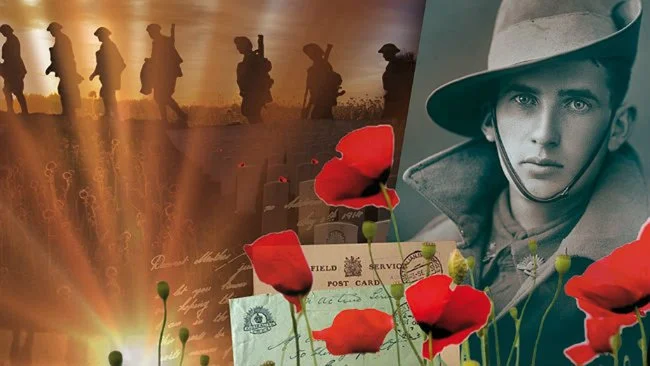
Commissioned as part of the 100th year anniversary commemoration of the beginning of World War I in 1914, this major work scored for S.A.T.B choir, childrens choir, S.S.T.B.B soloists and large orchestra was premiered in 2014 to critical acclaim. With music set to an outstanding libretto by Pamela TraynorI, based on letters exchanged between mothers and their sons during the war, it has been recognised as one of the finest works of its genre. The work was performed again in 2018 on the occasion of the 100th anniversary of the end of the Great War”
In 2013 I undertook a short but very intense trip to Gallipoli and the battlefieds of the Western Front in France in order to do some research and experience first hand the locations where history in all its brutality had taken place. During that journey I kept a diary. This is a brief excerpt.
“As one travels through the idyllic-countryside of… the Somme, suddenly in the midst of a cornfield there is a cemetery with row upon row of white headstones… From a distance a cross can often be discerned on the horizon rising up to the heavens and it is inconceivable, beyond comprehension that once, such a gentle and beautiful landscape was a quagmire, a sea of mud, trenches, craters, a place where the stench of death was all around.
I cannot forget the cemetery just outside of Villers-Brettoneux. Set on a gentle slope and with a cold wind blowing in the early morning light, I was profoundly moved and inspired by the sounds, the images which invoked a haunting music.”
EXCERPTS from AUSTRALIAN WAR REQUIEM
“Shells Burst”
https://www.youtube.com/watch?v=L5gjl4UVTzM&list=PLiC5DlytABtTNkO5jlePB9zBirzpSic57&index=3
“Oh Mother!”
https://www.youtube.com/watch?v=YjmAi3hLn8c&list=PLiC5DlytABtTNkO5jlePB9zBirzpSic57&index=1
“Oh my dear son!”
https://www.youtube.com/watch?v=oqdNuqcF57o&list=PLiC5DlytABtTNkO5jlePB9zBirzpSic57&index=2
“At day break” & Nurse’s aria “Soon after he came to us”
https://www.youtube.com/watch?v=A9hcyaFzIsI&list=PLiC5DlytABtTNkO5jlePB9zBirzpSic57&index=4
“They shall not grow old”
https://www.youtube.com/watch?v=5XQxWvgLyGw&list=PLiC5DlytABtTNkO5jlePB9zBirzpSic57&index=5
DÉMOCRATIE
In a letter to Paul Demeny dated May 15, 1871, the then seventeen year old Arthur Rimbaud writes;
“So then, the poet is truly a thief of fire. Humanity is his responsibility, even the animals; he must see to it that his inventions can be smelled, felt and heard. If what he brings back from beyond has form, he gives it form, if it is formless, he gives it formlessness. A language must be found; as a matter of fact, all speech being an idea, the time of a universal language will come!”
“This harangue would be of the soul for the soul, summing up everything, perfumes, sounds, colours, thought grappling thought, and pulling. The poet would define the amount of unknown arising in his time in the universal soul; he would give more than the formula of his thought, more than the annotation of his march toward Progress! Enormity become norm, absorbed by everyone, he would truly be the multiplier of progress!”
“This eternal art will have its functions since poets are citizens. Poetry will no longer accompany action but will lead it”
Remarkable words indeed from a youth born in provincial Charleville near the Belgian border. Rimbaud’s literary gifts were precocious and when one considers the political instability of the time (war with Prussia and the formation of the Commune in Paris) combined with the testosterone charged physical and intellectual desires of a youth suffocated by an inflexible, authoritarian upbringing, it is little wonder that he fled his home and embarked on a wild journey through life that would scandalise Europe and eventually end somewhat prematurely in 1891 after a colourful career as a gun-runner in Africa.
Rimbaud’s short literary career triggered off a revolution in literature. Considered to be the first “symbolist” words took on new meanings through his potent imagery and use of language. Without a doubt , his decision to be provocative at all times was a conscious one, and his various letters formulating his ideas about poetry and prose confirm this.
His prose-poem “Démocratie” which is part of a collection entitled “Illuminations” is in many ways a remarkably contemporary poem with its cynical and satirical examination of a democracy over-run by the avarice and manipulations of various power groups.
When I was commissioned to write a work to celebrate the “golden jubilee” of the Sydney University Graduate Choir, I was given an open brief and after having searched in vain for months for a suitable text I suddenly remembered the collection of prose-poems by Rimbaud in my personal library. “Démocratie” immediately grabbed my attention and musical ideas started to form.
It is not my intention to make a political statement with this work, as politics from my perspective has become a rather futile and impotent means by which to implement positive change for society as a whole. Democracy in its most ideal form is fast diminishing, hi-jacked by those whose only concern is to increase their own power to the exclusion of others. One can rationalise any change in many ways and justify it but if the mechanisms of change demean humanity and its most basic and fundamental qualities, then I would question its motives.
I have always felt that it is better to be silent about one’s artistic endeavours and leave the conclusions to those individuals who experience them.
Christopher Bowen, July 29th, 2002
DÉMOCRATIE
from “Illuminations” by Arthur Rimbaud (1854 – 1891)
“Le drapeau va au paysage immonde, et notre patois etouffe le tambour. “Aux centres nous alimenterons la plus cynique prostitution. Nous massacrerons les revoltes logiques. “Aux pays poivres et detrempes! – au service des plus monstreuses exploitations industrielles ou militaires. “Au revoir ici, n’importe ou. Conscrits du bon vouloir, nous aurons la philosophie feroce; ignorants pour la science, roues pour le confort; la crevaison pour le monde qui va. C’est la vraie marche. En avant, route!”
*
“The flag goes to the stinking countryside, And our “patois” drowns out the drum. In urban centres we shall support the most shameless corruption. We shall annihilate any thinking opposition. Even to the exotic, rain-drenched regions! – Under the control of the most monstrous exploitations, industrial or military. Till we meet again, here, no matter where. Sworn to goodwill, ours will be a savage philosophy; Ignoring knowledge, obsessed with our own comfort; Collapse of the world as we know it. This is the true path. Forward march, let’s go!”
(translation by Joan Whittaker)
SWEET SILENCE AFTER BELLS
I first became acquainted with the poetry of Christopher Brennan in February 2009, during a memorial service for Lady Joyce Black in the Great Hall of Sydney University,
On the last page of the order of service was a poem entitled “Sweet Silence after Bells”, and was immediately struck by its beauty of language, imagery and the powerful music lying beneath the surface of the text. I immediately set the poem to music and the work received its premiere later that year. So began my relationship with one of Australia’s finest poets and as I further explored his poetry I became increasingly astounded by its universality.
The composition is a haunting response to the exquisite text
SWEET SILENCE AFTER BELLS
Sweet silence after bells! deep in the enamour’d ear soft incantation dwells.
Filling the rapt still sphere a liquid crystal swims, precarious yet clear.
Those metal quiring hymns shaped ether so succinct: a while, or it dislimns.
the silence, wanly prinkt with forms of lingering notes, inhabits, close, distinct;
and night, the angel, floats on wings of blessing spread o’er all the gather’d cotes
where meditation, wed with love, in gold-lit cells absorbs the heaven that shed sweet silence after bells
SONGS OF THE HEART
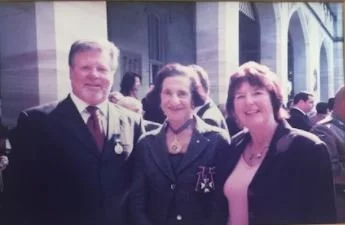
“Songs of the Heart” , a cycle of five pieces based on poems by Christopher Brennan was commissioned in 2011 and dedicated to the recently deceased Dame Marie Bashir, former Chancellor of Sydney University, Governor of New South Wales and much loved Patron of the Sydney University Graduate Choir. It was premiered on Saturday December 10, 2011 in the Verbrugghen Hall at the Conservatorium of Music in a concert dedicated to her.
The movements of this work Choir and Orchestra are:
My heart was wandering in the sands I am so deep in day They stole the children in their sleep I am shut out of mine own heart It is so long ago!
Brennan was born in 1870 and in his time was considered to be one of the most important poets in the English speaking world. He was a brilliant scholar and linguist who was widely read in English, French, German, Greek, Latin and Italian. The Christopher Brennan Award is presented annually to an Australian poet recognising a lifetime achievement in poetry. There is a Brennan Hall and Library named after him at Sydney University and the Christopher Brennan building in the University’s Arts Faculty is named in his honour.
At the time of the premiere I wrote the following:
“ I am moved by the music within his words, by their alliterations, their subtle rhythms and phrases that describe emotions in such a tender and profound manner. Such beguiling lines as “I am so deep in day”, “I am shut out of mine own heart” and “My heart was wandering in the sands” lead the reader into a subterranean world which never loses contact with reality and it this resulting tension that attracts my musical instincts and provokes the creative juices.
For me, as a composer, a poem must not only invite interpretation of the text through the intellect but be able to involve the senses through its colour and atmosphere. One has to feel its text, taste its language and smell its aromas. I experience these qualities in Brennan’s poetry and to merely evaluate his worth as a poet within the confines of the Antipodes is a grave injustice to a man who deserves greater recognition.”
MY HEART WAS WANDERING IN THE SANDS
My heart was wandering in the sands, a restless thing, a scorn apart; Love set his fire in my hands, I clasped the flame unto my heart.
Surely, I said, my heart shall turn one fierce delight of pointed flame; and in that holocaust shall burn its old unrest and scorn and shame:
surely my heart the heavens at last shall storm with fiery orisons, and know, enthroned in the vast, the fervid peace of molten suns.
The flame that feeds upon my heart fades or flares, by wild winds controll’d: my heart still walks a thing apart, my heart is restless as of old.
SIMPLE LITTLE SYMBOL
(after the manner of Maurice Maeterlinck)
They stole the children in their sleep they locked the maiden in the keep and sold the prince to citizens
They set him in the filthy street they drew the lines about his feet
In dreams he heard the princess weep he burst the magic of his feet And left behind the city’s dens
By day and night she calls to me the captive of the inner keep – What years ere I shall find the key ?
I AM SHUT OUT OF MINE OWN HEART
I am shut out of mine own heart because my love is far from me, nor in the wonders have I part that fill its hidden empery:
the wildwood of adventurous thought and lands of dawn my dream had won, the riches out of Faery brought are buried with our bridal sun.
And I am in a narrow place, and all its little streets are cold, because the absence of her face has robb’d the sullen air of gold.
My home is in a broader day: at times I catch it glistening thro, the dull gate, a flowr’d play and odour of undying spring:
the long days that I lived alone, sweet madness of the springs I miss’d, are shed beyond, and thro’ them blown clear laughter, and my lips are kiss’d:
-and here, from mine own joy apart, I wait the turning of the key: - I am shut out of mine own heart because my love is far from me.
IT IS SO LONG AGO!
It is so long ago! How shall the man I now am know the man I was before you came? I have forgot his name It was so long ago – How shall I know?
It is so long ago the time when life was faint and low the time that was not love you came, And call’d me by my name: It is so long ago – A month or so!